Single Tasking: Why Doing One Thing at a Time Makes You Dramatically More Productive
Single tasking means focusing on one task completely before moving to the next. The neuroscience is unambiguous: multitasking makes you slower, not faster.

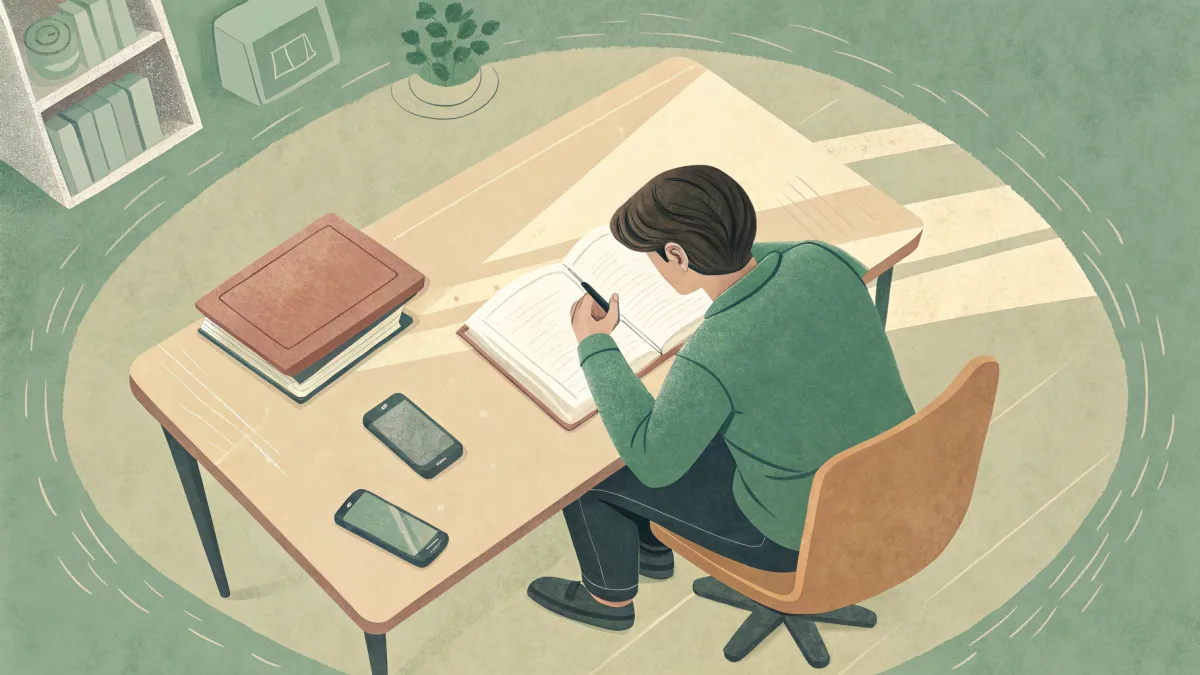
Most people believe they can multitask. Most people are wrong.
Not wrong in the "it's slightly less efficient" sense. Wrong in the "your brain is physically incapable of doing it" sense. What we experience as multitasking is rapid switching between tasks, and every switch carries a hidden cost that compounds across the entire workday.
Single tasking is the practice of giving one task your complete, undivided attention before moving to the next. It is not a productivity hack or a personality trait. It is how the human brain actually works when allowed to perform at its best.
Make10000Hours tracks your focus sessions in real time and shows you exactly how many times your attention switches during a work block. Most knowledge workers are surprised by the number. The data changes how you design your day.
What Is Single Tasking?
Single tasking means working on one specific task with full attention, until you reach a natural stopping point, before switching to anything else. No notifications running in the background. No open browser tabs beyond what the task requires. No phone within peripheral vision.
It is the opposite of the way most modern knowledge work actually happens: email open in one tab, Slack pinging in another, the main project in a third, a meeting on the calendar in 20 minutes creating low-level background urgency throughout.
Single tasking does not require a perfectly silent environment or the ability to focus for four unbroken hours. It requires a single clear task, a defined time window, and the removal of competing demands on your attention for that window.
The Science: Multitasking Is Physically Impossible
The case against multitasking is not a matter of opinion. It is basic cognitive neuroscience.
The cognitive bottleneck. In 1992, psychologist Harold Pashler described the brain's "cognitive bottleneck": the finding that the brain cannot engage in two cognitive tasks simultaneously. What we experience as thinking, deciding, or processing information all passes through a single central processor. You can walk and talk. You cannot write an email and follow a presentation at the same time. You can do only one of those things; the other is being ignored.
What multitaskers actually do. When you believe you're multitasking, you are actually serializing: switching rapidly between tasks, giving each a brief burst of attention before switching back. The cost of each switch accumulates. A 2009 study by Ophir, Nass, and Wagner published in the Proceedings of the National Academy of Sciences found something striking: heavy media multitaskers, the people most practiced at working with multiple simultaneous inputs, performed worse on cognitive tasks than light multitaskers. They were less able to filter irrelevant information, less able to switch tasks efficiently, and less able to hold information in working memory. Worse, they believed they were more productive than they were.
The 23-minute recovery cost. Gloria Mark's research at UC Irvine found that the average time required to fully regain deep focus after a single interruption is 23 minutes. This is not the time to stop feeling distracted. This is the time to return to the same cognitive depth that existed before the interruption.
The fMRI evidence. A 2014 study by Loh and Kanai found that people who multitask heavily show reduced gray matter density in the anterior cingulate cortex, the brain region responsible for cognitive control and attention regulation. Long-term multitasking may not just reduce performance in the short term. It may reshape the brain's capacity for sustained attention.
What Multitasking Actually Costs You: The Math
Abstract research is easy to dismiss. Concrete math is harder.
Take a conservative estimate: 10 genuine interruptions per workday. These include checking notifications, switching apps, glancing at messages during a work block, and brief context-switches between tasks. 10 interruptions × 23 minutes of recovery = 230 minutes of recovery time per day.
That is 3.8 hours of potential focused work lost to task-switching overhead. In an 8-hour day, you may be operating at an effective focus capacity of 4 hours or less, not because you lack discipline, but because the switching overhead consumes half the available cognitive time before any actual work happens.
The students who interrupted themselves briefly to check messages for 3 seconds made twice as many errors returning to their task. Those interrupted for 5 seconds made four times as many errors. Not because of the information they saw. Because of the interruption itself.
Single tasking does not require superhuman focus. It requires protecting a unit of time from the interruption overhead that otherwise consumes it invisibly.
Single Tasking vs Multitasking vs Task Batching vs Deep Work
These terms are often used interchangeably but describe distinct practices.
| Practice | Definition | Time unit | Best for |
|---|---|---|---|
| Single tasking | One task with full attention until done | Per task | Any cognitively demanding work |
| Task batching | Group similar tasks, do them together | Per session | Email, admin, calls, reviews |
| Deep work | Distraction-free concentration on hard tasks | 1 to 4 hours | Complex creative and analytical work |
| Pomodoro Technique | 25-min focus intervals with breaks | 25 min + 5 min | Building focus stamina, managing energy |
| Timeboxing | Fixed time limit per task | Variable | Preventing scope creep |
Single tasking is the principle underlying all of these. Deep work is single tasking applied to cognitively demanding tasks for extended periods. Task batching is single tasking applied to entire categories of work. The Pomodoro technique is single tasking structured around time intervals.
You can practice single tasking without any formal system. But pairing it with time blocking creates the most reliable daily structure: block specific time for specific tasks, then single-task within those blocks.
How to Build a Single-Tasking Practice
Step 1: Define the task before you start. "Work on the project" is not a single-tasking task. "Write the introduction section of the Q3 report" is. The specificity matters because vague tasks create decision overhead during the work session. You end up choosing what to do instead of doing it.
Step 2: Close everything that isn't required. Before starting, close every browser tab unrelated to the task. Close your email client. Put your phone face-down in another room (Adrian Ward's 2017 research showed that a phone's mere presence on a desk reduces available cognitive capacity, even when turned face-down). This is not willpower. It is environment design.
Step 3: Set a defined end point. Work on the task until it is done, or until a specific time you set in advance. Open-ended sessions invite drift. A defined container keeps the task bounded and prevents the focus window from dissolving into unrelated browsing.
Step 4: When you feel the urge to switch, write it down instead. The pull to check messages, look something up, or switch tasks is constant. Instead of resisting it indefinitely (which is exhausting) or following it (which costs you the 23-minute recovery), keep a "parking lot" note open. Write the impulse down and return to it after the session ends. The impulse loses its urgency once externalized.
Step 5: Build up gradually. Most people can sustain genuine single-tasking for 20 to 30 minutes before their concentration begins to fragment. Start there. Set a 25-minute timer, single-task for that window, take a real break. Then extend the window as the habit builds. Expecting to single-task for 90 minutes on day one is how the practice fails before it starts.

Single Tasking for ADHD and Knowledge Workers
For people with ADHD, single tasking is simultaneously the most valuable practice and the hardest to execute.
The ADHD brain does not multitask by choice. It multitasks because sustaining attention on a single unrewarding task without external stimulation is genuinely difficult at a neurological level. The dopamine deficit in ADHD means that tasks requiring sustained focus do not generate enough intrinsic reward to hold attention without assistance.
This creates a pattern: the ADHD brain seeks stimulation by adding inputs (phone, music, multiple screens, background TV) in an attempt to reach a sufficient arousal level for work. The inputs feel helpful in the moment but multiply the interruption cost.
Strategies that help ADHD brains single-task more effectively:
Use interest as a filter. ADHD executive function responds to novelty, urgency, interest, and challenge (Dr. William Dodson's NICE model). When choosing what to single-task on, pair challenging tasks with a genuine interest element: frame the task as a challenge with a timer, find the part that is personally meaningful, or use the Pomodoro technique to create urgency through a ticking clock.
Body doubling. Working alongside another person, physically or via video, activates social accountability circuits that can sustain attention for ADHD brains. Virtual coworking sessions or a simple video call with a colleague working on their own tasks works for many people.
Reduce the cognitive cost of staying on task. Open only the minimum necessary to do the work. Every additional open tab, notification badge, or ambient sound competes for the attention that ADHD struggles to hold. The environment needs to do the work that the executive function cannot.
Make10000Hours was designed with this in mind. It monitors your computer activity and categorizes it in real time: when you're single-tasking on your primary work, when you've drifted into distraction, and when you've lost the session entirely. For ADHD knowledge workers, having an external observer that doesn't require self-reporting is often the first time they see an honest picture of their actual focus patterns.
The Hardest Part: Protecting Focus in an Interruption Culture
The structural problem with single tasking in modern knowledge work is not willpower. It is that the work environment is designed, often unintentionally, to maximize interruptions.
Open-plan offices. Always-on Slack. Email expected within the hour. Meeting culture that fragments the day into 30-minute blocks. These are not personal failures. They are system-level choices that make single tasking nearly impossible without deliberate counter-design.
Three structural changes that make a real difference:
Notification audit. Disable all non-essential notifications. Calls and direct messages from specific people can remain. Everything else turns off during focus windows. Email notifications should be off entirely for anyone doing cognitively demanding work: designated email windows accomplish the same communication goal without the interruption overhead.
Meeting consolidation. Audit your weekly meetings and identify which ones could be asynchronous. Cluster the remaining necessary meetings into two or three meeting-heavy days. Protect the remaining days for deep single-tasking work. This is the single highest-leverage scheduling change most knowledge workers can make.
Physical device boundaries. Phone in another room during focus blocks. This is the most consistently effective single intervention in the research on attention and productivity. Not silenced. Not face-down. In another room.
Frequently Asked Questions
What is single tasking?
Single tasking means giving one task your complete, undivided attention until you reach a stopping point before switching to anything else. It is the opposite of multitasking, which is the rapid sequential switching between tasks that creates attention fragmentation and error.
Is single tasking actually more productive than multitasking?
Yes, for all cognitively demanding work. The research is unambiguous: the brain cannot process two cognitive tasks simultaneously. What we experience as multitasking is serial task-switching, with a recovery cost of approximately 23 minutes per interruption. Heavy multitaskers perform measurably worse on cognitive tasks than light multitaskers, and (critically) they believe they are performing better.
How do you practice single tasking?
Define the specific task before starting. Close everything unrelated to the task. Put your phone out of sight. Set a defined time window. When the urge to switch arises, write it on a parking lot note instead of following it. Start with 25-minute sessions and build from there.
What is the cognitive bottleneck?
The cognitive bottleneck, described by Harold Pashler in 1992, is the finding that the brain can only engage in one cognitive phase at a time. Perception, processing, and action can overlap in simple motor tasks. But thinking, deciding, and understanding all pass through a single central processor. You cannot truly think about two things simultaneously.
How much time does task-switching waste per day?
Using Gloria Mark's 23-minute recovery figure and a conservative estimate of 10 task-switches per day, the switching overhead costs approximately 3.8 hours of potential focus time per workday. In practice, many knowledge workers interrupt themselves far more than 10 times per day, making the effective focus time even shorter.
Does single tasking work for ADHD?
It is particularly valuable for ADHD, but requires specific adaptations. ADHD brains seek stimulation when a task does not provide sufficient intrinsic reward, leading to habitual multitasking as an arousal strategy. Effective adaptations: pair tasks with interest or urgency framing, use body doubling, reduce environmental competition for attention (one open tab, phone in another room), and use external timers to create the urgency that sustains attention.
What is the difference between single tasking and deep work?
Single tasking is the principle: one task, full attention. Deep work is the practice of applying single tasking to cognitively demanding tasks for extended, protected sessions. Deep work is single tasking with intensity, duration, and intentional scheduling. You can single-task a 10-minute email response. Deep work requires a protected 90-minute block and a task that pushes cognitive limits.
How do I stop multitasking when my job requires it?
Most jobs require responsiveness, not simultaneous cognitive processing. The distinction matters. You can be responsive to Slack and email during designated windows while single-tasking during focus blocks. The goal is not to eliminate communication. It is to prevent communication from fragmenting every focus session with interruptions that each cost 23 minutes to recover from. Consolidate communication into defined windows and protect the focus windows completely.
Every hour of genuine single-tasking produces more than two hours of fragmented multitasking. The math works in your favor. The environment just needs to be designed to let it.