Maker's Schedule vs Manager's Schedule: How to Protect the Time That Actually Produces Your Best Work
Paul Graham's 2009 essay identified two incompatible ways of structuring time. Fifteen years later, the collision between them explains most of the productivity problems in modern knowledge work.

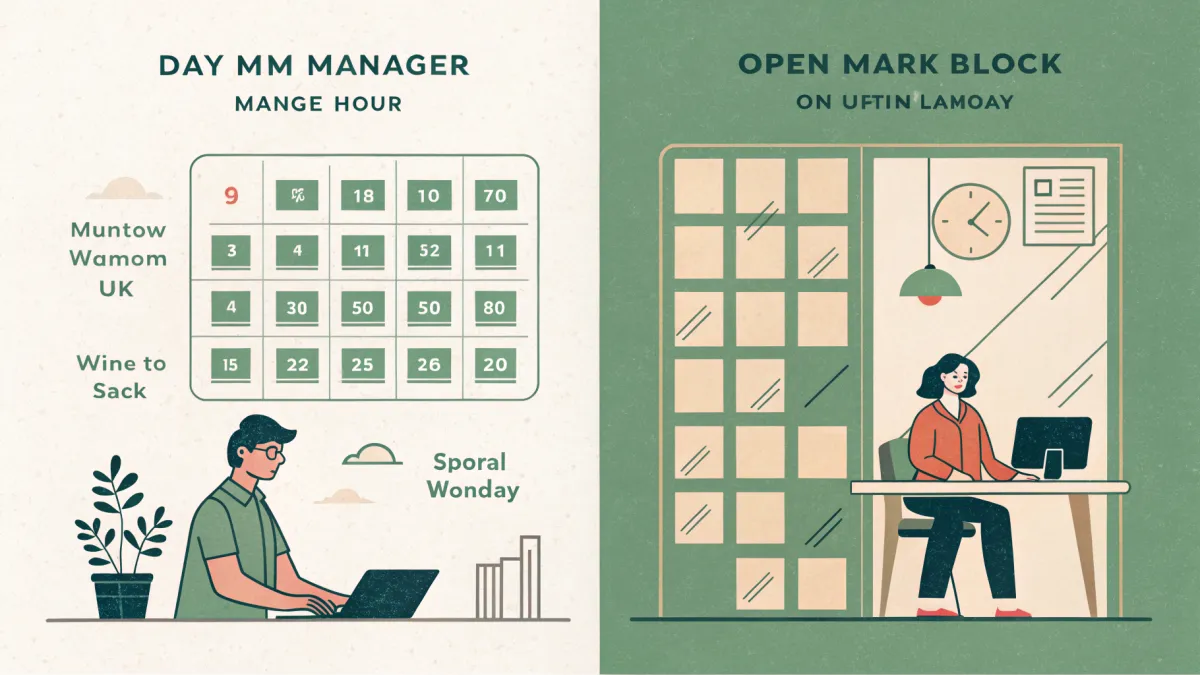
In 2009, programmer and Y Combinator co-founder Paul Graham published a short essay called "Maker's Schedule, Manager's Schedule." In fewer than 900 words, he articulated something that developers, writers, designers, and anyone else who produces complex output had felt but never quite named.
The insight: there are two fundamentally different ways of using time, and they are largely incompatible. When the people who use one system are put in the same organization as people who use the other, the collision almost always destroys the first.
Graham identified the two schedules this way:
The manager's schedule divides the day into one-hour intervals. Each hour is a slot. Something can be booked into any slot. The cost of any single meeting is just that one slot. The manager's schedule is the default for executives, coordinators, salespeople, and anyone whose primary output is decisions, communication, and oversight.
The maker's schedule works in half-day units at minimum. Makers (programmers, writers, designers, researchers, engineers) need large, unbroken blocks of time to produce meaningful output. "You can't write or program well in units of an hour," Graham wrote. "That's barely enough time to get started."
The problem is not meetings. The problem is a single meeting inside a maker's day.
"A single meeting can blow a whole afternoon," Graham wrote, "by breaking it into two pieces each too small to do anything hard in."
Make10000Hours tracks how your deep work time is actually structured throughout the day, making it easy to see exactly how many unbroken focus blocks you're getting, and where meetings, messages, and reactive tasks are fragmenting them.
Why a Single Meeting Costs More Than Its Duration
Graham described the cost intuitively. Research has since explained the mechanism precisely.
Dr. Sophie Leroy at the University of Washington coined the term "attention residue" to describe what happens when you switch from one task to another before completing it. Her 2009 research showed that the cognitive representation of the interrupted task remains partially active in working memory after the switch. You are nominally on the new task, but part of your attention is still processing the incomplete previous one.
For a manager switching from one meeting to another, attention residue is manageable. Both tasks involve communication and social processing. The cognitive modes are similar. The residue from one does not heavily disrupt the other.
For a maker, a 10am meeting inserted into a coding or writing session creates a completely different pattern. The maker must:
- Stop deep work at some point before 10am to decompress and transition
- Attend the meeting, switching entirely into communication and social processing mode
- Return from the meeting and attempt to reload the complex mental model of the previous work
Step 3 is where the cost becomes visible. Reloading a complex problem context takes 15 to 20 minutes at minimum. For deep technical or creative work, full re-engagement may take longer. Research by Gloria Mark (UC Irvine) found that full refocus after interruption takes an average of 23 minutes. Add the pre-meeting wind-down and the post-meeting recovery, and a 30-minute meeting consumes 60 to 90 minutes of effective maker time.
Graham captured the psychological dimension too: "If I know the afternoon is going to be broken up, I'm slightly less likely to start something ambitious in the morning. I know this may sound oversensitive, but if you're a maker, think of your own case. Don't your spirits rise at the thought of having an entire day free to work, with no appointments at all? Well, that means your spirits are correspondingly depressed when you don't."
The anticipation of fragmentation impairs the quality of work done before the interruption.
Who Is on the Maker's Schedule?
Any knowledge worker whose output requires sustained, deep concentration falls on the maker's schedule side of this divide. The defining criterion is not job title but cognitive demand:
Software engineers and developers: Writing code, debugging, system design, architecture review, and code reading all require holding complex state in working memory simultaneously. A developer working on a difficult problem has a "compiler in their head": a running model of the system's state, edge cases, and constraints. Interrupting this model is not merely pausing it. It requires rebuilding it from scratch on return.
Writers and content creators: Long-form writing, whether code documentation, articles, reports, or marketing copy, requires maintaining narrative coherence across hundreds or thousands of choices. Interruption during drafting creates the need to re-read, reconnect, and re-establish voice and argument before continuing.
Designers: Complex design work involves visual system thinking, holding multiple constraints simultaneously (user needs, technical limits, brand guidelines, accessibility) and making thousands of micro-decisions within those constraints. The creative state required for design is easily broken and slow to rebuild.
Researchers and analysts: Deep analytical work requires building a running mental model of a problem and iteratively refining it. Each interruption requires partially rebuilding the model from external notes rather than from live working memory.
Freelancers across all disciplines: Freelancers frequently manage multiple concurrent projects, which means each project context is a separate mental model. Interruptions between client work and administrative tasks compound the maker's schedule problem.
The 3-Step System for Protecting Maker Time
Graham's original essay described the solution he used: office hours. Cluster all meetings at the end of the working day, in a single continuous block, so that the rest of the day is uninterrupted maker time.
This is still the most effective single intervention. Here is a complete 3-step system that extends it:
Step 1: Audit your current fragmentation. For one week, log every interruption to your maker time. Count how many meetings, messages, and reactive tasks break your focus blocks before you reach 90 minutes of uninterrupted concentration. This baseline reveals the actual cost you are paying and creates the motivation to change it.
Step 2: Protect maker blocks structurally. Use time blocking to reserve your highest-energy hours (typically the first 2 to 3 hours of your working day) as inviolable maker time. Mark these blocks on your calendar. Set your status to unavailable. Close Slack. During maker time, you are not in communication mode.
Step 3: Batch all manager-mode work into defined windows. Meetings, email, Slack, code reviews, administrative tasks, and client communication all go into designated windows outside your maker blocks. For most maker-schedule workers, one communication window at late morning and one at end of day is sufficient to handle all synchronous and asynchronous demands. Graham's office-hours model (clustering at end of day) works particularly well for independent contributors.
The goal is not to avoid communication. It is to ensure that communication happens at times when the context-switching cost is low and that maker work happens in unbroken blocks where it can actually proceed.

Communicating Maker Needs in Manager-Schedule Organizations
Most organizations default to the manager's schedule because most organizational power sits with people on the manager's schedule. Calendar invites propagate on the manager's model. Open-door cultures assume hour-based availability. The default expectation is that a meeting at any time is a reasonable ask.
Navigating this requires explicit communication rather than silent resistance.
Explain the cognitive cost directly. Most managers who schedule 10am meetings with engineers have never thought through the refocus cost. "I do my best work in 2-3 hour blocks, and a mid-morning meeting means I lose the whole morning's deep work window" is a concrete, professional explanation that most good managers respond to.
Propose an alternative that serves both schedules. "Can we move this to 11:30 or right after lunch? I can give you my full attention then, and it keeps my morning block intact." This reframes the request as a benefit to the meeting quality, not as resistance to the meeting itself.
Use calendar signals proactively. Block your maker time on your calendar with a visible label. "Deep Work Block" or "Focus Time" as a visible calendar entry communicates your schedule structure without requiring repeated conversations.
Advocate for team-level norms. For engineering teams, product teams, and creative departments, team-wide no-meeting morning blocks are one of the highest-leverage structural changes an organization can make. Basecamp, Shopify, and other engineering-first companies have implemented these policies explicitly, often citing Graham's original essay.
Maker's Schedule for Freelancers and Remote Workers
For freelancers, the maker's schedule problem takes a different form. There is no manager booking meetings into your calendar, but there are clients, messages, Slack pings, and the constant low-level pressure to be available and responsive.
The default remote work setup often recreates the worst aspects of the manager's schedule without any of its organizational benefits: continuous partial attention to communication channels, reactive responsiveness to client requests, and fragmented work that moves slowly despite long working hours.
The solution is identical in principle to Graham's: batch all client communication into defined windows and protect the rest of the day as maker time.
In practice: two client communication windows per day (morning check-in and end-of-day update) handle the overwhelming majority of client needs. Any remaining client-side urgency that truly cannot wait can be flagged as such, creating a clear distinction between routine communication and genuine emergencies. Most clients, when their expectations are set clearly, are satisfied with two-daily communication touchpoints.
Task batching is the operational implementation of the maker's schedule for freelancers: batch all client communication, invoicing, and administrative work into defined slots and protect the remaining hours for the actual billable work.
For ADHD freelancers and remote workers, the maker's schedule is especially critical. The ADHD brain's default mode in an unstructured environment often defaults to reactive responsiveness: answering messages, attending to whatever is most stimulating at the moment, rather than the effortful, self-regulated initiation of deep creative work. Structural protection of maker time, combined with body doubling for the maker blocks themselves, addresses both the scheduling and the activation problems.
Frequently Asked Questions
What is the maker's schedule?
The maker's schedule is a way of using time developed by people who produce complex output, like programmers, writers, and designers. It works in large, unbroken blocks of at least half a day. Paul Graham, programmer and Y Combinator co-founder, described it in a 2009 essay: "You can't write or program well in units of an hour. That's barely enough time to get started." A single meeting can destroy a maker's half-day by breaking it into two pieces too small for serious work.
What is the manager's schedule?
The manager's schedule divides the day into one-hour intervals, like a traditional appointment book. Any hour can accommodate a meeting. The cost of any single meeting is just that one slot. The manager's schedule suits executives, coordinators, and anyone whose primary work involves decisions, communication, and oversight, where task-switching between hourly slots is not cognitively costly.
Why does a single meeting ruin a maker's day?
Because of attention residue and context-switching cost. A meeting inserted into a maker's day requires: a wind-down period before the meeting (stopping deep work early), the meeting itself (switching to communication mode), and a re-engagement period after (rebuilding the mental model of the complex work). Research by Gloria Mark (UC Irvine) found refocusing takes 23 minutes on average. For deep technical or creative work, full re-engagement takes longer. The total cost of a 30-minute meeting in a maker's day is often 60 to 90 minutes of effective output.
How do you implement the maker's schedule?
Three steps: audit your current fragmentation (count how often meetings or interruptions break your focus blocks before you reach 90 minutes), protect maker blocks structurally (use time blocking to reserve your highest-energy morning hours as inviolable deep work time), and batch all manager-mode work into defined windows (one communication window at late morning, one at end of day). This clusters your meeting and communication costs rather than distributing them across the day.
How do you tell a manager you need maker schedule time?
Explain the cognitive cost directly and propose an alternative. "I do my best work in 2 to 3 hour unbroken blocks, and a mid-morning meeting means I lose the whole morning window. Can we move this to 11:30 or right after lunch? I'll give you my full attention then." Most managers respond positively to this framing because it positions the request as improving the quality of your contribution, not avoiding the meeting.
Does the maker's schedule apply to non-programmers?
Yes. Any knowledge worker whose output requires sustained concentration falls on the maker's schedule side. Writers, designers, researchers, analysts, and content creators all benefit from large unbroken blocks. The maker-vs-manager distinction maps to the difference between work that requires building and holding complex mental models (makers) and work that involves processing discrete items and making decisions (managers). Many knowledge workers spend time on both sides, which is why protecting maker blocks explicitly is necessary.
How does the maker's schedule relate to deep work?
Cal Newport's concept of deep work is the cognitive science framing of what Paul Graham described from a practitioner perspective. Deep work is cognitively demanding work performed in a state of distraction-free concentration, the kind of work that creates the most value and is increasingly rare. The maker's schedule is the scheduling structure that creates the conditions for deep work. Deep work happens inside maker blocks. Manager-schedule fragmentation prevents it.
Can the maker's schedule work in a meeting-heavy organization?
Yes, with explicit communication and structural protection. The key tactics: block your maker time visibly on your calendar, propose meeting windows at end of day rather than mid-morning, advocate for team-level no-meeting morning policies, and use async communication tools (documents, recorded video, written updates) to reduce the number of meetings required in the first place. The maker's schedule is not anti-meeting. It is pro-uninterrupted-blocks, which means batching all meetings into concentrated windows rather than distributing them across the day.
Your best work requires your best hours. The maker's schedule is a commitment to protecting them.